Applied mathematics · European Industrial Doctorate
Reduced-order modelling for financial risk
Efficient, accuracy-controlled simulation of high-dimensional parametric models used in interest-rate and portfolio-risk analysis.
Technische Universität Berlin · MathConsult GmbH · Horizon 2020 ROMSOC
Journal of Mathematics in Industry · ETNA · 2021–2022
Abstract
This paper presents a model order reduction approach for large scale high dimensional parametric models arising in the analysis of financial risk. To understand the risks associated with a financial product, one has to perform several thousand computationally demanding simulations of the model which require efficient algorithms. We establish a model reduction approach based on a variant of the proper orthogonal decomposition method to generate small model approximations for the high dimensional parametric convection-diffusion-reaction partial differential equations. This approach requires to solve the full model at some selected parameter values to generate a reduced basis. We propose an adaptive greedy sampling technique based on surrogate modeling for the selection of the sample parameter set. The new technique is analyzed, implemented, and tested on industrial data of a floater with cap and floor under the Hull–White model. The results illustrate that the reduced model approach works well for short-rate models.
Introduction
Risk measures such as historical and Monte Carlo value at risk require a financial product to be evaluated under thousands of parameter scenarios. When valuation depends on high-dimensional convection–diffusion–reaction PDEs, repeated full-order simulation becomes too slow for practical risk analysis.
- Goal
- Make repeated valuation across thousands of financial-risk scenarios fast enough for practical analysis.
- Key idea
- Compress full-order solutions with POD and select informative parameter samples through adaptive, surrogate-assisted greedy search.
- Takeaway
- Compact models delivered substantial speed-up for the studied Hull–White products while supporting a user-defined total-error tolerance.
Methodology
High-fidelity solution snapshots were compressed using Proper Orthogonal Decomposition and singular value decomposition to construct a low-dimensional reduced basis. A surrogate-assisted greedy algorithm selected informative parameter samples rather than filling the parameter space uniformly. Projection onto the reduced basis then replaced the original system with a much smaller model.
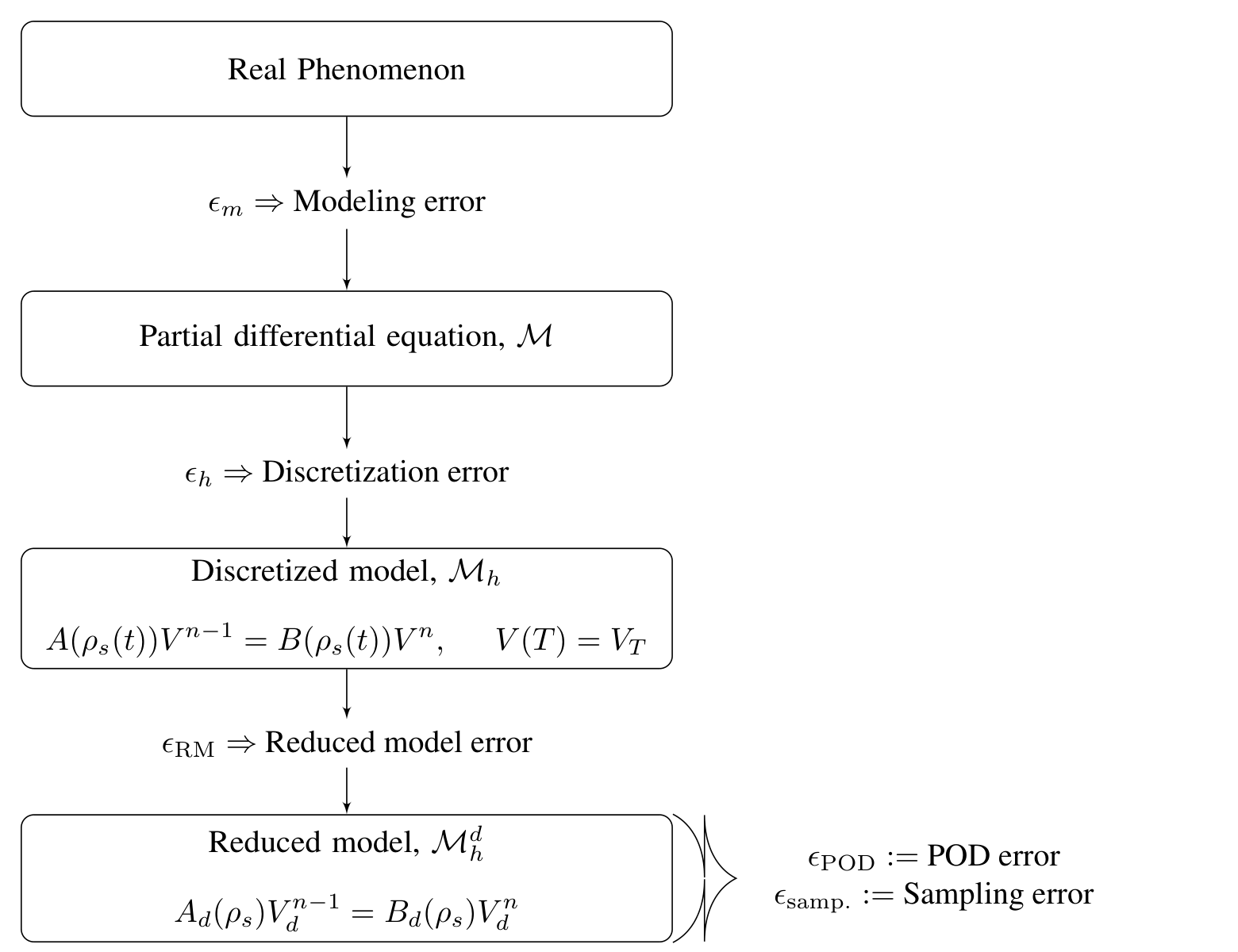
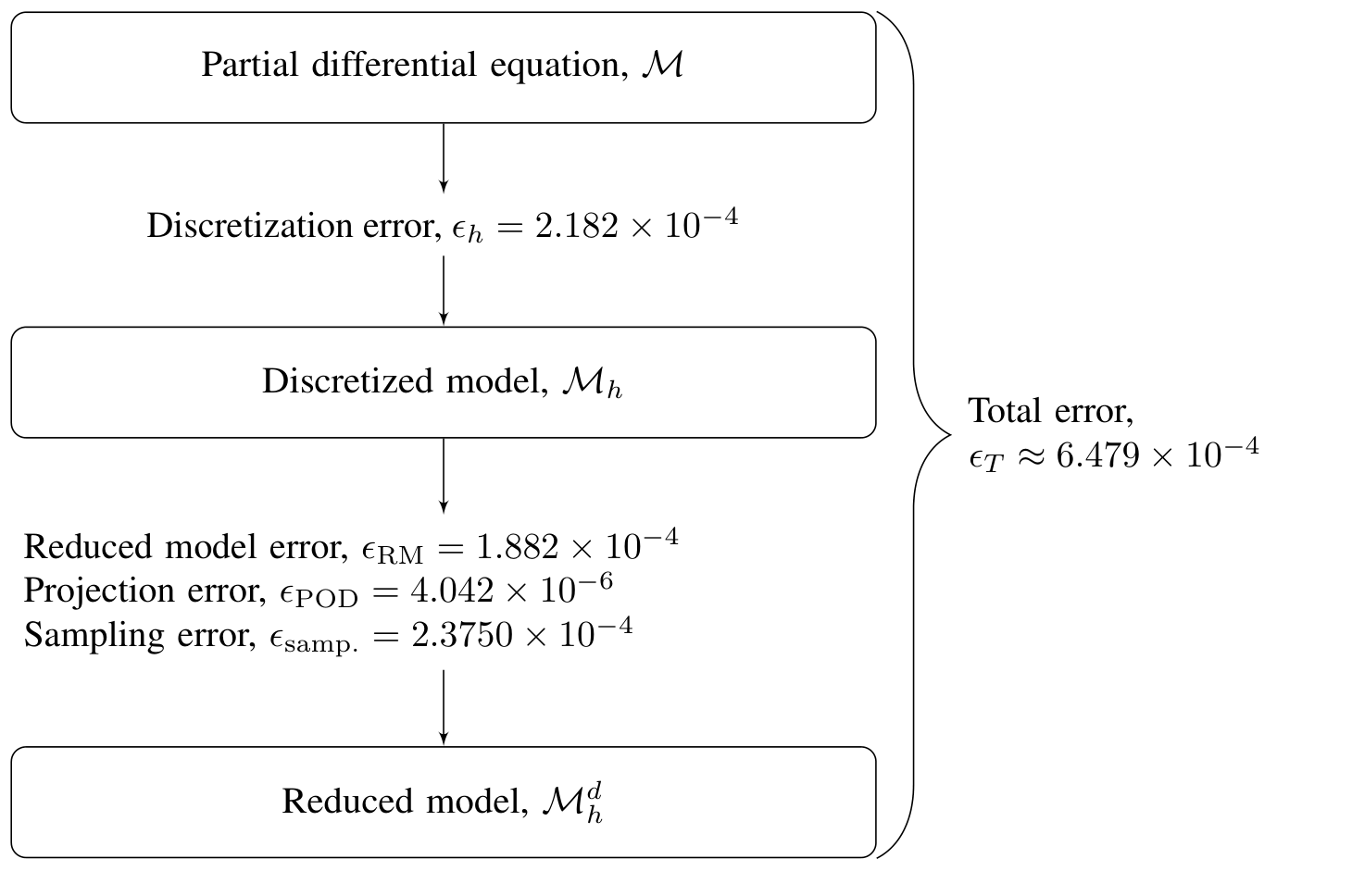
The framework separated total error into discretisation error from the full numerical model, projection error from model reduction and parameter-sampling error. This decomposition allowed the method to select a reduced model whose estimated total error remained below a user-defined tolerance.
Results and outcomes
The methods were evaluated on industrial interest-rate products, including a floater with cap and floor and a puttable steepener under Hull–White models. The reduced models delivered substantial speed-up while maintaining the accuracy required for repeated risk calculations.
- Adaptive sampling reduced the need for uniformly distributed full-order simulations.
- Separate error contributions supported accuracy-controlled model selection.
- The framework was demonstrated on practical short-rate product models.
Computational performance
For 10,000 parameter scenarios, the paper reports reduced-model evaluation times eight to ten times faster than the full model. Including basis-generation time, the classical greedy models were seven to nine times faster and the adaptive greedy models were six to eight times faster.
| Algorithm | Model | Eva. time, single ρs | Total Eva. time (Teva) | Total time, TQ + Teva |
|---|---|---|---|---|
| — | FM, M = 1600 | 1.9136 s | 19316.5 s | 19316.5 s |
| Classical greedy sampling | RM, d = 5 | 0.198 s | 1975.31 s | 2253.7 s |
| Classical greedy sampling | RM, d = 10 | 0.268 s | 2681.45 s | 2959.9 s |
| Adaptive greedy sampling | RM, d = 5 | 0.214 s | 2143.47 s | 2531.1 s |
| Adaptive greedy sampling | RM, d = 10 | 0.263 s | 2671.30 s | 3058.9 s |
Source: Table 4.6 in Error Analysis of a Model Order Reduction Framework for Financial Risk Analysis. FM denotes the full model; RM denotes a reduced model.
Puttable-steepener scenarios
The reduced model and the commercial UnRisk software were evaluated over 10,000 scenarios. The reported favourable, moderate and unfavourable outcomes correspond to the 90th, 50th and 10th percentiles, respectively.
| Performance scenario | 5 years | 10 years | ||
|---|---|---|---|---|
| RM | UnRisk | RM | UnRisk | |
| Favorable (90th percentile) | 0.983 | 0.972 | 1.001 | 0.994 |
| Moderate (50th percentile) | 0.931 | 0.926 | 0.940 | 0.934 |
| Unfavorable (10th percentile) | 0.907 | 0.904 | 0.912 | 0.919 |
Source: Table 4.7 in Error Analysis of a Model Order Reduction Framework for Financial Risk Analysis. Values are reproduced as reported in the paper.
Technology and research setting
This European Industrial Doctorate was conducted between Technische Universität Berlin and MathConsult GmbH under the EU Horizon 2020 ROMSOC network. Core methods included parametric PDEs, POD/SVD, adaptive greedy sampling, optimisation, surrogate modelling and numerical error analysis.
BibTeX
@article{binder2021model,
  author  = {Binder, Andreas and Jadhav, Onkar and Mehrmann, Volker},
  title   = {Model order reduction for the simulation of parametric interest rate models in financial risk analysis},
  journal = {Journal of Mathematics in Industry},
  year    = {2021},
  volume  = {11},
  pages   = {8},
  doi     = {10.1186/s13362-021-00105-8},
  url     = {https://doi.org/10.1186/s13362-021-00105-8}
}
Research outputs
- Model order reduction for the simulation of parametric interest rate models in financial risk analysis, Journal of Mathematics in Industry (2021).
- Error analysis of a model order reduction framework for financial risk analysis, Electronic Transactions on Numerical Analysis 55 (2022).