Generative modelling · Vision Transformers · 2026
Patch-PODiff-ViT
Structured latent diffusion with patchwise POD for super-resolution and uncertainty quantification.
The University of Western Australia
arXiv preprint, 2026
Abstract
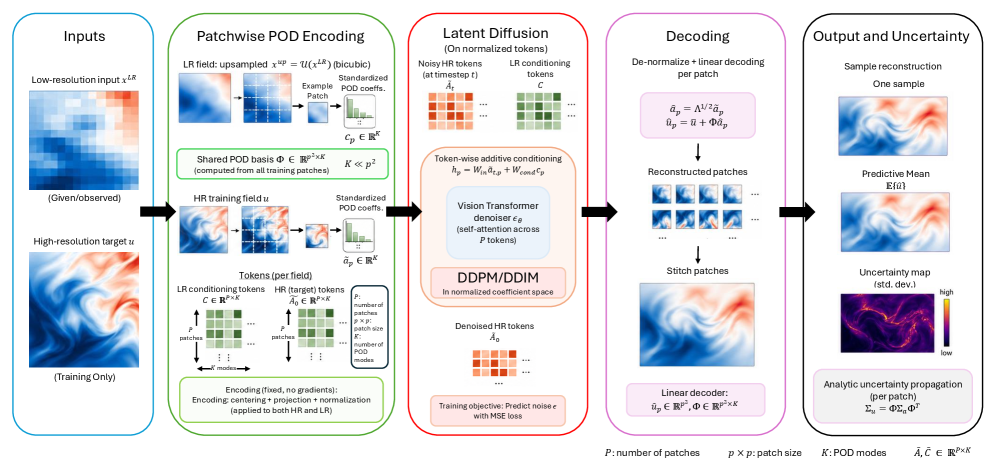
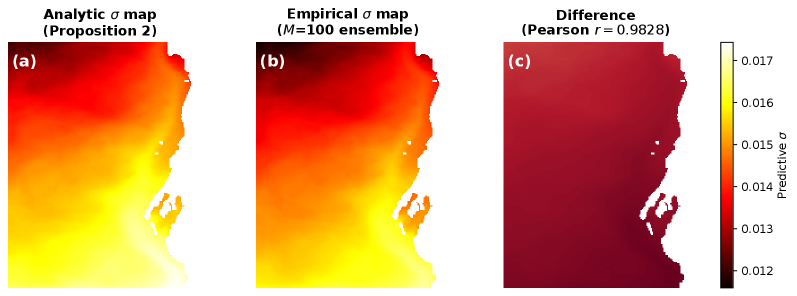
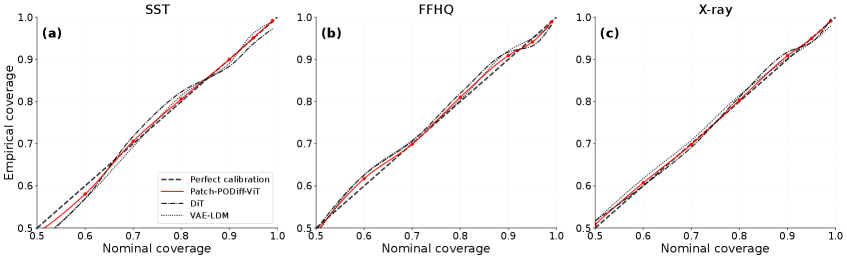
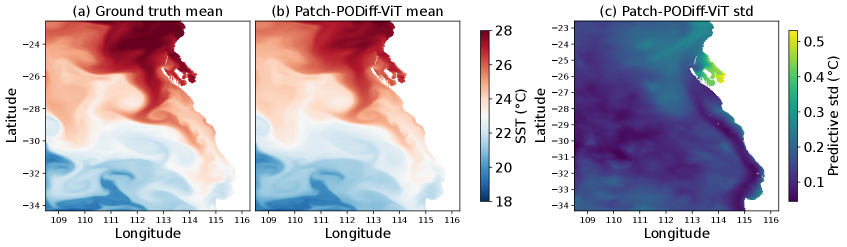
Diffusion models enable probabilistic super-resolution and conditional generation, but pixel-space methods are computationally expensive and learned latent spaces often lack interpretable uncertainty quantification. We introduce Patch-PODiff-ViT, a structured latent diffusion framework in which the latent space is defined by patchwise Proper Orthogonal Decomposition (POD), a fixed linear orthonormal basis over local patches, rather than learned by a nonlinear autoencoder. This yields low-dimensional, variance-ordered tokens that preserve spatial structure and enable efficient diffusion in a structured low-dimensional latent space with a Vision Transformer. Because the decoder is fixed, linear, and orthonormal, latent coefficient uncertainty can be propagated directly to physical-space predictive variance, enabling analytic propagation of predictive variance through the linear decoder without Monte Carlo estimation in pixel space. Across sea surface temperature, medical imaging, and natural images, the method achieves strong reconstruction with fewer parameters and lower memory, while producing well-calibrated spatial uncertainty that closely matches empirical ensembles.
Introduction
A single global POD basis is efficient but can under-represent local structures when datasets contain heterogeneous spatial patterns. Scientific and medical images also require uncertainty at the pixel or physical-location level, where repeated Monte Carlo decoding can become expensive.
- Goal
- Preserve local image structure while making uncertainty-aware super-resolution compact enough for scientific and medical applications.
- Key idea
- Represent local patches as variance-ordered orthonormal tokens and model their interactions with a conditional Vision Transformer.
- Takeaway
- The fixed linear decoder makes it possible to propagate predictive variance analytically from latent coefficients into physical space.
Methodology
Patch-PODiff-ViT divides each high-resolution field into local patches and constructs an orthonormal POD basis for the patch representation. The resulting low-dimensional tokens retain local spatial information. A conditional Vision Transformer models interactions between tokens and performs diffusion in this structured latent space.
Because reconstruction uses a fixed linear orthonormal decoder, coefficient-space predictive variance can be propagated analytically into pixel space. This provides spatial uncertainty maps without estimating every statistic through repeated nonlinear decoding.
Results and significance
- Patchwise, variance-ordered latent tokens that preserve local structure.
- A Vision Transformer denoiser for interactions across spatial patches.
- Analytical propagation of predictive variance through the fixed decoder.
- A unified evaluation across sea-surface temperature, medical imaging and natural images.
The method achieved strong reconstruction with fewer parameters and lower memory use while producing spatial uncertainty that closely followed empirical ensembles. It extends structured scientific diffusion beyond a single domain and supports applications where calibrated uncertainty is essential.
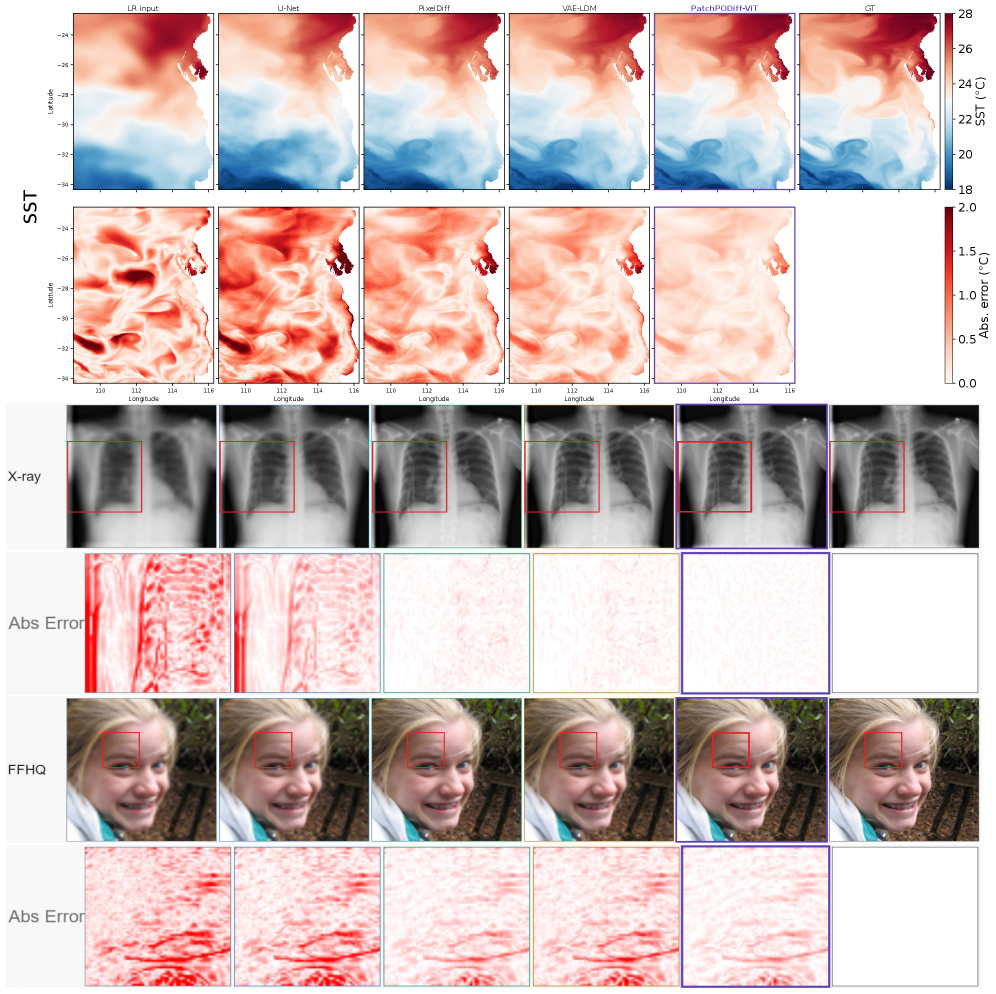
Reconstruction across domains
| Metric | Patch-PODiff-ViT | VAE-LDM | DiT | PixelDiff | U-Net | Fullfield-PODiff |
|---|---|---|---|---|---|---|
| SST (Sea Surface Temperature) | ||||||
| RMSE ↓ | 0.0030 | 0.0041 | 0.0040 | 0.0049 | 0.0093 | 0.0049 |
| PSNR ↑ | 50.43 | 47.73 | 47.95 | 46.23 | 40.63 | 46.22 |
| SSIM ↑ | 0.9888 | 0.9799 | 0.9707 | 0.9713 | 0.9589 | 0.9690 |
| LPIPS ↓ | 0.0131 | 0.0201 | 0.0169 | 0.0234 | 0.0295 | 0.0267 |
| FID ↓ | 3.986 | 5.90 | 5.01 | 8.46 | 11.96 | 8.49 |
| Chest X-ray | ||||||
| RMSE ↓ | 0.0065 | 0.0087 | 0.0081 | 0.0098 | 0.0133 | 0.0092 |
| PSNR ↑ | 42.98 | 39.11 | 41.21 | 37.64 | 34.52 | 35.75 |
| SSIM ↑ | 0.9885 | 0.9790 | 0.9632 | 0.9743 | 0.9423 | 0.9699 |
| LPIPS ↓ | 0.0201 | 0.0298 | 0.0281 | 0.0310 | 0.0422 | 0.0307 |
| FID ↓ | 6.0152 | 8.17 | 7.01 | 11.44 | 13.65 | 9.26 |
| FFHQ (Face Images) | ||||||
| RMSE ↓ | 0.0109 | 0.0178 | 0.0121 | 0.0147 | 0.0361 | 0.0154 |
| PSNR ↑ | 39.15 | 36.44 | 38.04 | 37.87 | 32.54 | 37.15 |
| SSIM ↑ | 0.9522 | 0.9321 | 0.9432 | 0.9411 | 0.9255 | 0.9358 |
| LPIPS ↓ | 0.0300 | 0.0561 | 0.0377 | 0.0427 | 0.0584 | 0.0471 |
| FID ↓ | 9.168 | 11.98 | 10.04 | 10.11 | 16.18 | 12.08 |
Results are averages over three seed runs; the paper reports standard deviations separately in Appendix Table 5. Bold values reproduce the best entries in the original table. Source: paper Table 1.
Uncertainty quantification
Computational efficiency
| Model | Parameters (M) | Training (h) | GPU memory (GB) | Inference (s) | M=100 ensemble (s) |
|---|---|---|---|---|---|
| Patch-PODiff-ViT | 70 | 8.7 | 8.6 | 0.109 | 11.036 |
| VAE-LDM | 220 | 30.6 | 16.1 | 0.255 | 26.038 |
| DiT | 75 | 10.2 | 9.2 | 0.112 | 11.855 |
| PixelDiff | 160 | 26.8 | 12.3 | 1.800 | 189.530 |
The final column reports generation of a 100-member ensemble. Source: paper Table 2.
Technology and data
Python, PyTorch, Vision Transformers, patchwise POD, diffusion models, sea-surface-temperature datasets, MRI/X-ray imagery and natural-image benchmarks.
Research outputs
BibTeX
Cite the arXiv preprint:
@misc{jadhav2026patchpodiffvit,
  title         = {{Patch-PODiff-ViT}: Structured Latent Diffusion
                   with Patchwise POD for Super-Resolution and
                   Uncertainty Quantification},
  author        = {Jadhav, Onkar and French, Tim and Rayson, Matthew
                   and Jones, Nicole L.},
  year          = {2026},
  eprint        = {2606.31290},
  archivePrefix = {arXiv},
  primaryClass  = {cs.LG},
  doi           = {10.48550/arXiv.2606.31290},
  url           = {https://arxiv.org/abs/2606.31290}
}