Climate modelling · Ocean AI · 2025
Residual correction neural nets: SST downscaling
Deep-learning methods for converting coarse seasonal forecasts into high-resolution coastal sea-surface-temperature information.
The University of Western Australia
ESS Open Archive, 2025
Abstract
Global forecasts cannot resolve coastal ocean structure, while dynamical downscaling is prohibitively expensive for ensembles and long coastlines. This project combines a U-Net with a Residual Corrective Neural Network to iteratively refine ACCESS-S2 forecasts toward 2 km ROMS fields. Dynamically scaled residuals recover eddies and fronts, and a custom loss-assisted variant targets extremes absent from training data. Applied to Western Australia’s 2011 marine heatwave, the framework resolves fine-scale anomalies while balancing computational efficiency and local accuracy.
The study specifically treats ACCESS-S2 sea-surface-temperature forecasts as the coarse input and regional ROMS fields as the learning target, increasing horizontal detail from 25 km to 2 km along Western Australia. The resulting statistical workflow is intended to strengthen coastal forecasting while remaining efficient enough for management and marine-ecosystem applications.
Read the complete abstract in the official UWA research record.
Research problem and study design
Global seasonal forecasts represent basin-scale variability but do not resolve the coastal fronts, eddies and sharp near-shore gradients needed for regional decision-making. The study treats high-resolution ROMS output off Western Australia as the reference field and asks whether a statistical model can recover that structure from coarse ACCESS-S2 forecasts at a fraction of the cost of repeated dynamical downscaling.
- Low-resolution input
- ACCESS-S2 ocean forecasts, including sea-surface temperature, salinity and mixed-layer depth, augmented with ERA5 surface-flux variables.
- High-resolution target
- Approximately 2 km ROMS sea-surface-temperature fields for the Western Australian coastal domain.
- Evaluation
- Models trained with the 2015–2020 dataset were evaluated over daily 2021 fields for the complete spatial domain.
Methodology
The baseline first interpolates the coarse forecast onto the ROMS grid. A U-Net then predicts an initial high-resolution solution. The Residual Corrective Neural Network (RCNN) is trained on the remaining error, r = y − yinitial, and adds that learned correction to the initial field. This decomposition lets the second network concentrate on coastal and fine-scale information that the first prediction misses.
The paper compares interpolation, a single U-Net and the full RCNN. Performance is reported with root-mean-square error (RMSE), the coefficient of determination (R²) and structural similarity (SSIM). Each entry below is the mean of the daily evaluation score over the full 2021 test year and entire study region.
Results
The residual-corrective model achieved the strongest result on every reported metric: it reduced RMSE relative to both interpolation and the single U-Net while increasing R² and SSIM.
| Model | RMSE (°C) ↓ | R² ↑ | SSIM ↑ |
|---|---|---|---|
| Interpolation | 0.939 | 0.825 | 0.975 |
| U-Net | 0.515 | 0.911 | 0.983 |
| RCNN | 0.389 | 0.955 | 0.998 |
RMSE is reported in degrees Celsius. R² and SSIM are dimensionless; arrows indicate the preferred direction. Values reproduce the paper exactly. Source: paper Table 3.
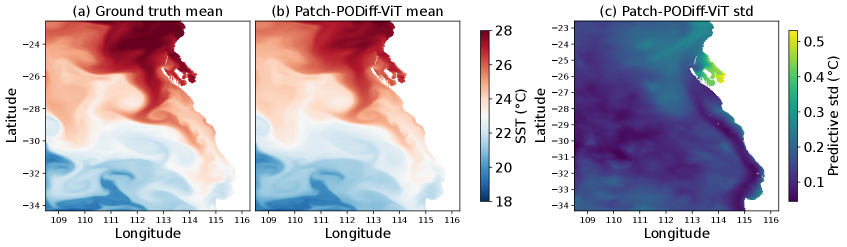
Spatial comparisons in the paper show that the RCNN retains the broad forecast signal while recovering sharper coastal gradients than interpolation or the single U-Net. At the Shark Bay coastal location, the 2021 daily time-series evaluation also demonstrates that the correction follows seasonal and shorter-period variability.
Scope and limitations
The reported scores measure agreement with ROMS rather than direct observational truth. They apply to the Western Australian domain, the stated training period and a held-out 2021 test year; transfer to other coastlines, forcing products or climate regimes requires separate evaluation. The framework is therefore best read as a statistically efficient complement to regional ocean modelling, not a replacement for process-based simulation.
Technology and data
Python, PyTorch, xarray, NetCDF and Dask; ACCESS-S2 ocean forecasts; ERA5 surface-flux fields; high-resolution ROMS simulations; and high-performance computing workflows on Setonix and NCI/Gadi.
BibTeX
@techreport{Jadhav2025RCNNSST,
  author      = {Jadhav, Onkar and French, Tim and Janekovi{\'c}, Ivica and Jones, Nicole and Rayson, Matt},
  title       = {Deep Learning-Based Statistical Downscaling of Sea Surface Temperature Using a Residual Corrective Neural Network},
  institution = {ESS Open Archive},
  type        = {Working Paper},
  year        = {2025},
  month       = aug,
  doi         = {10.22541/essoar.175510661.11731470/v1},
  url         = {https://doi.org/10.22541/essoar.175510661.11731470/v1}
}
Citation metadata from the official UWA research record.