Biomedical modelling · Model reduction
Thermoelectric generators for active implants
Compact thermal models for miniaturised devices that harvest temperature differences in human tissue to power medical implants.
MSc research · University of Rostock
Research outputs · 2017–2018
Abstract
Electrically active implants for regenerative therapies (e.g. regeneration of bone tissue or deep brain stimulation for the treatment of motion disorders) are gaining on importance within an aging population. The implants must be replaced during the course of the therapy. Their performance requirements vary from a few microwatts to a few milliwatts and will keep increasing with growing functionality. In order to extend the life of electrical active implants and thus avoid the expensive and risky operations for their replacement, a considerable amount of the implant’s energy requirement shall be covered by the conversion of mechanical or thermal body energy into electrical power. In this work, we present a multiphysical model of a miniaturized thermoelectric generator for electrically active implants, which uses temperature gradients in human tissue. Based on this model, we analyze the influence of the geometry and material parameters on the thermal and electrical properties and aim for an optimal transducer design. Furthermore, we use mathematical methods of model order reduction to create an accurate compact model that can be applied within a system simulation.
Introduction
Active medical implants commonly rely on batteries whose finite lifetime may require replacement surgery. The temperature gradient between the body core and skin offers a continuous energy source, but the performance of a miniaturised thermoelectric generator depends on tissue geometry, material properties, blood perfusion, ambient conditions and device design.
- Goal
- Evaluate body-heat energy harvesting for active implants without repeatedly solving a costly tissue-device model.
- Key idea
- Reduce a layered thermal tissue and thermoelectric-generator model while retaining nonlinear and parametric effects.
- Takeaway
- The compact models provide a pathway to efficient environmental, design and coupled device–circuit studies.
Methodology
The physical model represented a thermoelectric generator embedded in layered human tissue containing muscle, fat and skin. Heat transport included tissue conduction, boundary convection and temperature-dependent metabolic heat generation, allowing the available temperature difference across the generator to be estimated.
Several compact-modelling strategies were studied: snapshot-based linearisation of nonlinear heat inputs, parametric model reduction for ambient temperature and skin convection, and reduced representations suitable for repeated parameter studies and coupled device–circuit simulation.
Results and outcomes
- Design and analysis of a thermoelectric generator for electrically active implants.
- Nonlinear-input reduction of thermal human-tissue models.
- Parametric reduced models for efficient environmental and design studies.
- A pathway towards fast co-simulation of the generator, tissue and electrical circuitry.
Generator design and compact-model validation
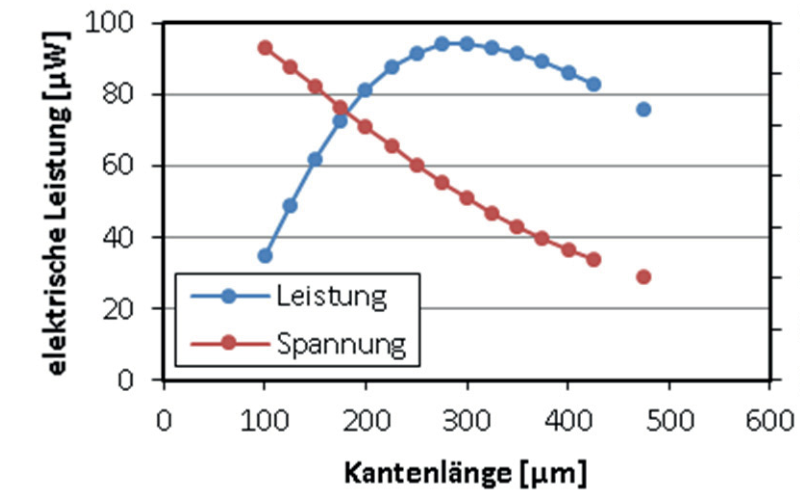
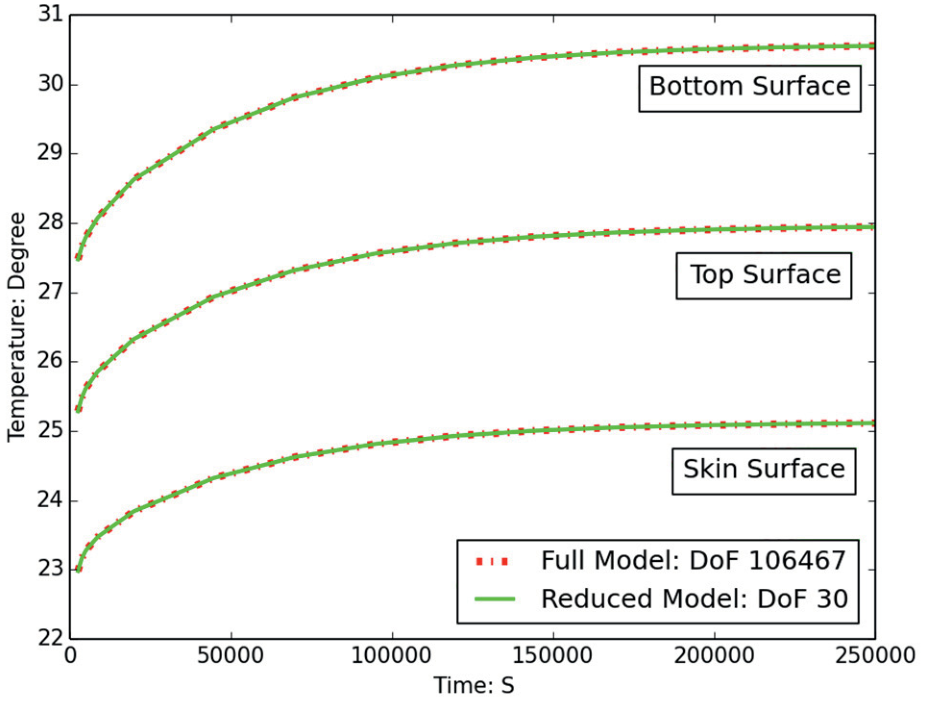
The source paper reports a maximum electrical power of 94.5 μW for a thermocouple-leg cross-section of 275 × 275 μm². Its transient thermal model was reduced from 106,467 to 30 degrees of freedom, and the full and reduced temperature histories closely overlap at the TEG and skin surfaces.
System-level power output
In the reported co-simulation, the load resistance was varied from 1 Ω to 100 Ω. The calculated TEG voltage was 84.72 mV, with the resistance sweep identifying the load region that maximised delivered power.
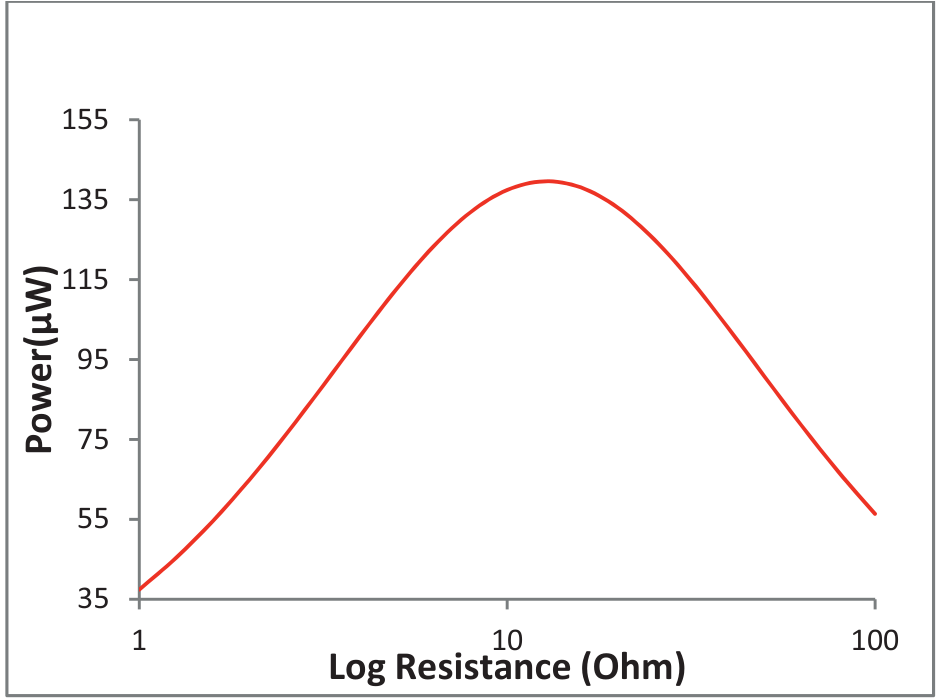
The paper’s results are presented here through its original figures and accompanying reported values; no additional results table has been constructed.
Technology and research setting
The work grew from MSc research at the University of Rostock and used finite-element thermal models, compact modelling, nonlinear and parametric model-order reduction, biomedical heat transfer and thermoelectric energy harvesting.
BibTeX
@inproceedings{jadhav2017design,
  author    = {Jadhav, Onkar Sandip and Yuan, Cheng Dong and Hohlfeld, Dennis and Bechtold, Tamara},
  title     = {Design of a thermoelectric generator for electrical active implants},
  booktitle = {MikroSystemTechnik 2017},
  year      = {2017},
  pages     = {402--405},
  publisher = {VDE Verlag},
  url       = {https://ieeexplore.ieee.org/document/8278689}
}
Research outputs
- Design of a thermoelectric generator for electrically active implants, IEEE MikroSystemTechnik Congress (2017).
- Nonlinear Model Order Reduction of Thermoelectric Generator for Electrically Active Implants, International Journal of Bioelectromagnetism (2018).
- Parametric Model Order Reduction of a Thermoelectric Generator for Electrically Active Implants, EuroSimE (2018).
- Load Snapshot Based Nonlinear-Input Model Order Reduction of a Thermal Human Tissue Model, SCEE (2018).