2023–present
Research Fellow - Machine Learning and AI
University of Western Australia, Perth
Australian Bureau of Meteorology : Research engagement on sea-surface-temperature downscaling
Scientific AI · Applied mathematics · Climate intelligence · Medical AI
I am an applied mathematician, climate modeller and scientific machine-learning researcher specialising in uncertainty-aware generative AI for climate science and medical data. I am currently a Research Fellow at The University of Western Australia, with more than seven years of international research experience across Australia, Germany, Austria and Luxembourg.
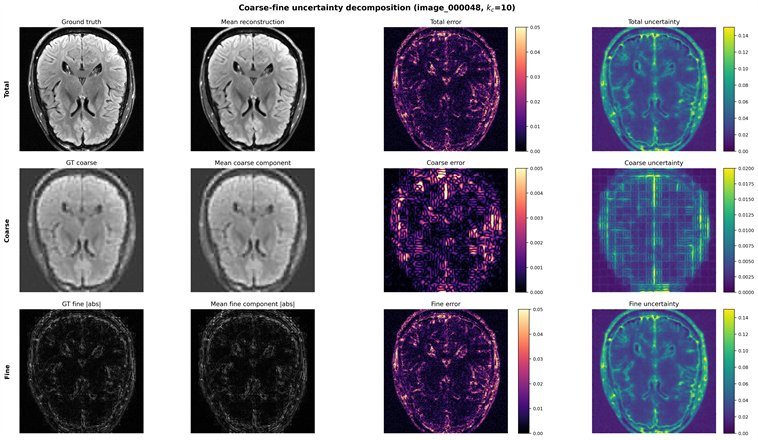
My research includes PODiff, an uncertainty-aware generative-AI framework accepted at ICML 2026, and high-resolution sea-surface-temperature downscaling for marine heatwaves, coastal risk and climate resilience. I also develop Med-PODiff for brain-MRI reconstruction and hallucination-risk detection, with direct relevance to Australia’s health industries.
My Australian research engagement includes an invited seminar at the Australian Bureau of Meteorology and research collaboration with RMIT University. I was previously a Marie Skłodowska-Curie Fellow under EU Horizon 2020 and currently contribute to the machine-learning community as an ICML 2026 Gold Reviewer and invited reviewer for AAAI and NeurIPS. I also convened WIM2021, an international workshop on simulation and optimisation.
2023–present
University of Western Australia, Perth
Australian Bureau of Meteorology : Research engagement on sea-surface-temperature downscaling
August 2026–present
RMIT
2022–2023
University of Luxembourg
2018–2021
Technische Universität Berlin and MathConsult GmbH
2017–2018
University of Rostock
2022
Technische Universität Berlin
European Industrial Doctorate and Marie Skłodowska-Curie Fellowship in the ROMSOC network.
2018
University of Rostock
Thesis on nonlinear model-order reduction of thermoelectric generators for active implants.
2015
University of Pune
Foundation in computational engineering, mechanics, thermodynamics and numerical modelling.
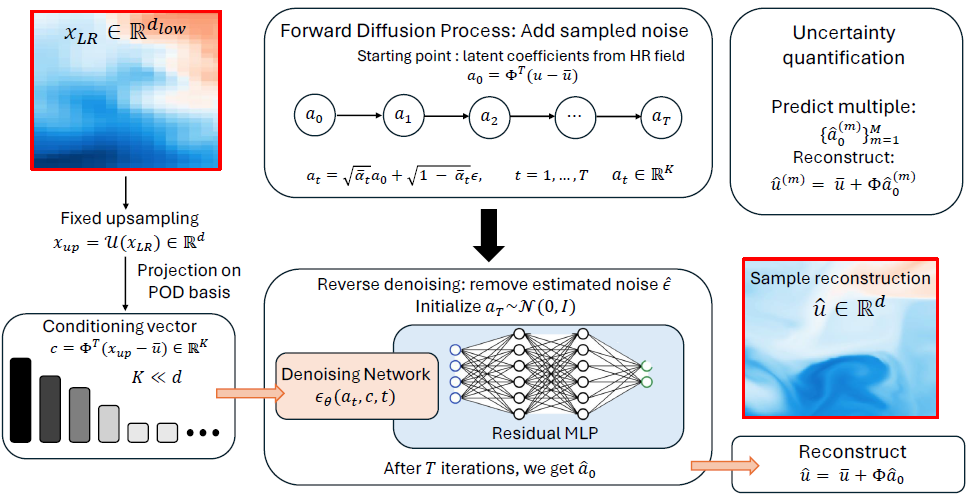
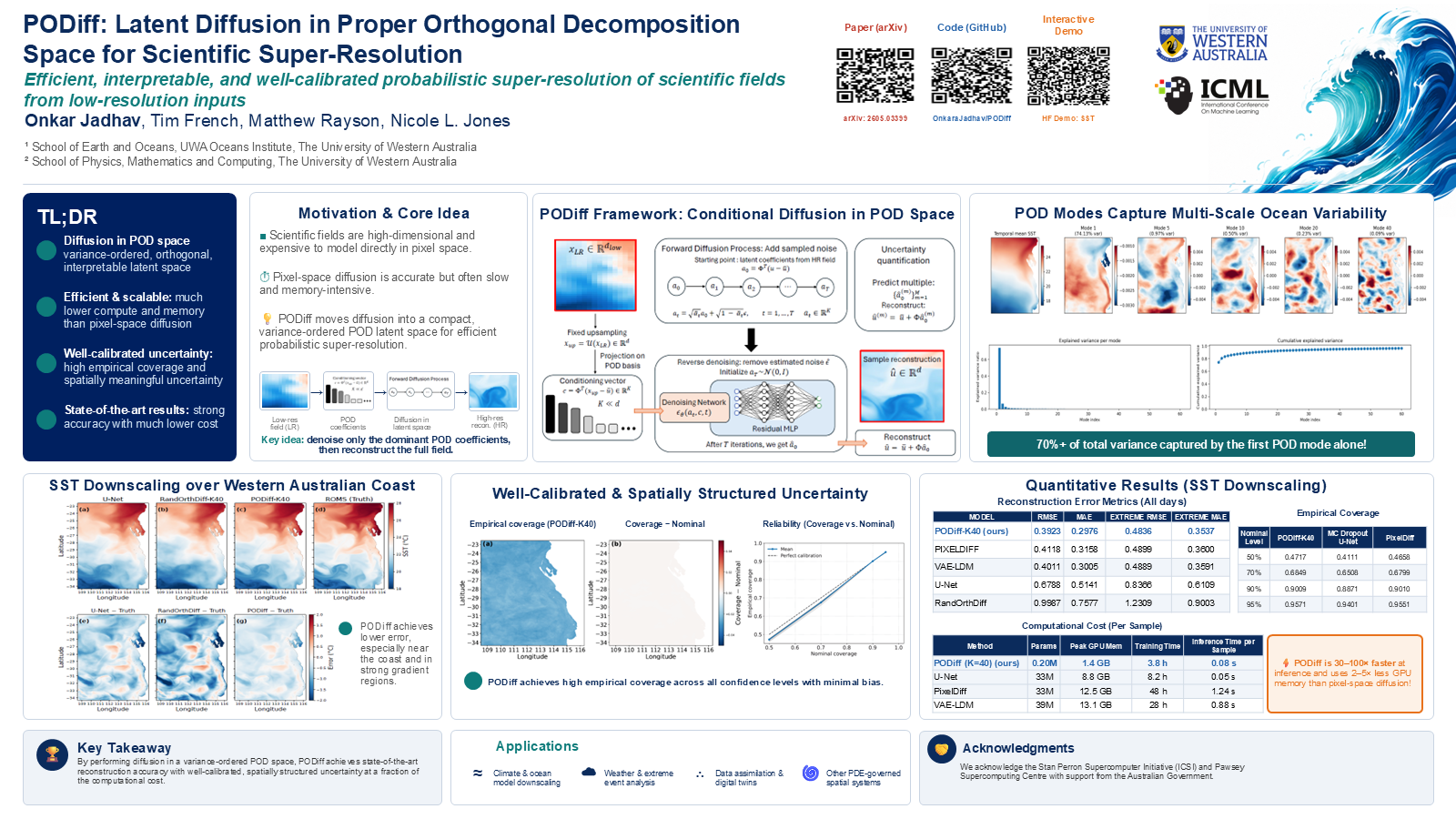
I lead the development of PODiff, a conditional diffusion framework that works in a fixed Proper Orthogonal Decomposition space rather than directly on full-resolution pixels. The POD representation orders latent variables by explained variance and preserves a direct relationship between generated coefficients and physical spatial modes. This makes ensemble generation less computationally demanding and allows uncertainty to be examined in a structured, interpretable way. PODiff has been accepted at ICML 2026.
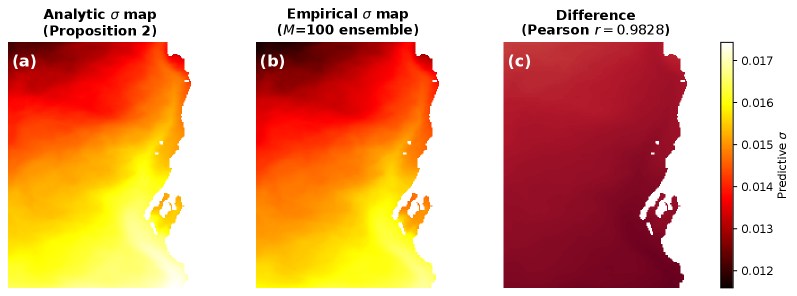
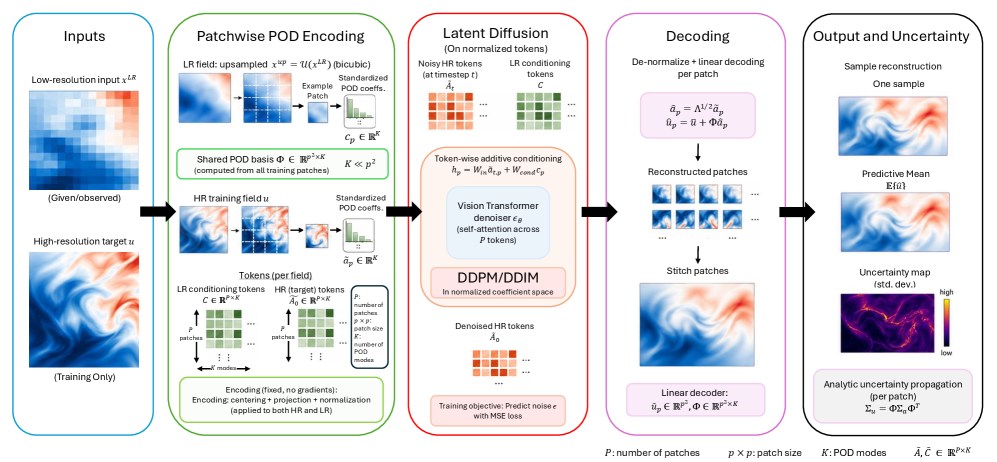
I am extending this work through Patch-PODiff-ViT. The method represents local image patches as compact orthonormal tokens and uses a Vision Transformer to model interactions between them. Because the decoder is fixed and linear, predictive uncertainty can be propagated analytically from the latent coefficients to the reconstructed physical field. The framework is being evaluated across sea-surface temperature, medical imaging and natural-image datasets.
In parallel, I develop statistical-downscaling systems for coastal sea-surface temperature. These pipelines combine seasonal forecast ensembles, regional ocean simulations, climate-model projections and satellite observations. Residual-corrective neural networks learn the fine-scale coastal structure absent from coarse operational forecasts.
The aim is not simply to produce a sharper temperature map. Forecast ensembles are converted into daily exceedance probabilities, persistence measures and location-specific marine-heatwave information. These outputs are intended to support coastal planning, fisheries and reef management, marine operations and climate-risk assessment in Western Australia.
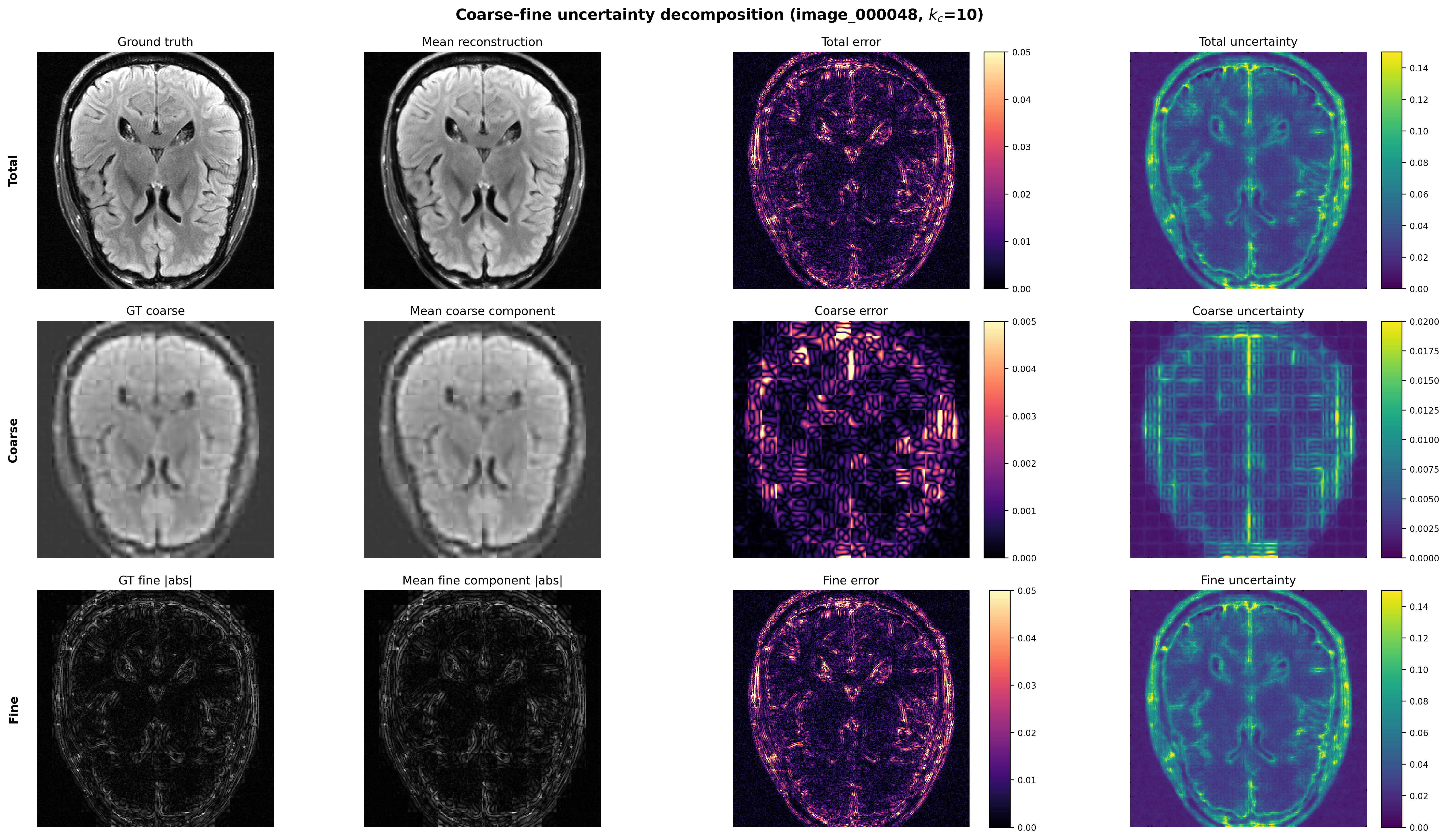
A further strand of the research asks how structured latent models can reveal when a reconstruction should not be trusted. Current work studies calibrated predictive intervals, scale-dependent uncertainty and indicators of hallucination or failure in medical-image super-resolution. This provides a bridge between environmental intelligence and reliable AI for other high-stakes scientific applications.
The work is conducted with collaborators across the UWA Oceans Institute, the School of Earth and Oceans, and computer science and applied mathematics. Experiments run on Setonix and NCI/Gadi using reproducible Python, PyTorch, Docker and Singularity workflows. Results are communicated through peer-reviewed papers, open preprints, research talks, visualisations and interactive demonstrations.
Selected research bringing together applied mathematics, deep learning, generative methods and domain science. Each summary is adapted from the corresponding paper abstract; follow the project page for details.
ICML . 2025 - 2026
Probabilistic super-resolution of high-dimensional spatial fields is expensive in pixel space. PODiff instead performs conditional diffusion in a fixed, variance-ordered POD coefficient space, enabling efficient ensembles, interpretable latent geometry and well-calibrated spatial uncertainty at substantially lower computational cost.
2026 - Present
Patch-PODiff-ViT defines a structured latent space using patchwise POD rather than a nonlinear autoencoder. Its low-dimensional, variance-ordered tokens preserve local structure for Vision Transformer diffusion, while the fixed orthonormal decoder propagates latent uncertainty analytically into physical-space predictive variance without pixel-space Monte Carlo estimation.
2023 - Present
Global forecasts cannot resolve coastal ocean structure, while dynamical downscaling is prohibitively expensive for ensembles and long coastlines. This project combines a U-Net with a Residual Corrective Neural Network to iteratively refine ACCESS-S2 forecasts toward 2 km ROMS fields. Dynamically scaled residuals recover eddies and fronts, and a custom loss-assisted variant targets extremes absent from training data. Applied to Western Australia’s 2011 marine heatwave, the framework resolves fine-scale anomalies while balancing computational efficiency and local accuracy.
2026 - Present
Med-PODiff extends uncertainty-aware generative AI to medical imaging, with current work on brain-MRI reconstruction, calibrated uncertainty and hallucination-risk detection.
Building and Environment . 2022 - 2023
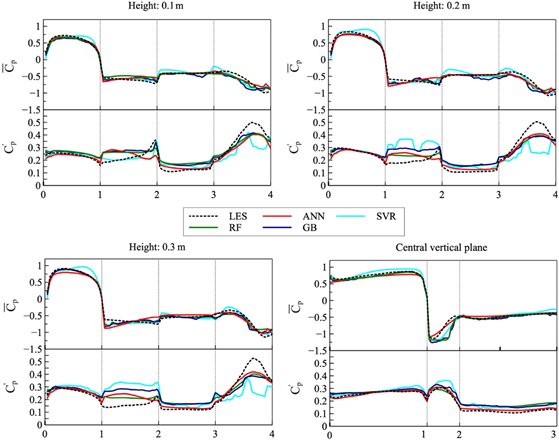
RANS simulations estimate wind pressure efficiently across many directions but lack accuracy, whereas LES is accurate but costly. This project combines both through multi-fidelity machine learning. Using LES data for only three wind directions, the framework predicts mean and RMS pressures across the full wind rose; an artificial neural network performed best, and hyperparameter optimisation improved RMS-pressure R² by 60%.
Journal of Mathematics in Industry . 2018 - 2022
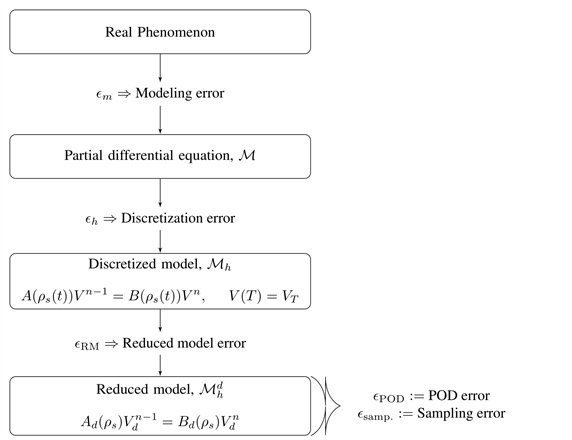
Financial risk analysis can require thousands of expensive simulations of high-dimensional parametric PDEs. This project uses POD-based model reduction with adaptive, surrogate-assisted greedy sampling to build compact approximations from selected full-model solutions. Tests on Hull–White interest-rate products show that the reduced approach works efficiently for short-rate models.
IEEE . 2017 - 2018
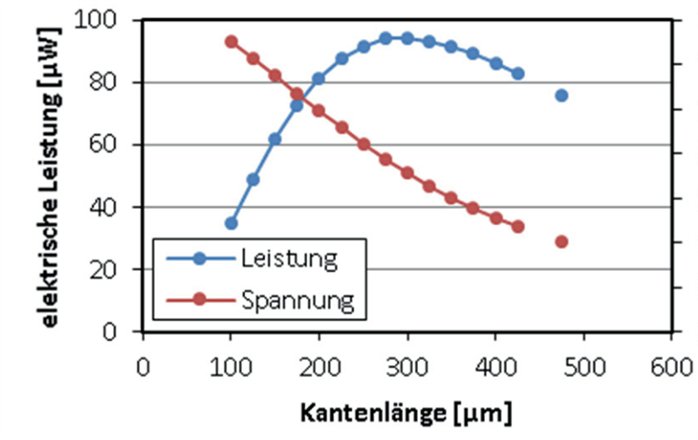
Electrically active implants need reliable energy sources. This work models a miniaturised thermoelectric generator that converts body-temperature gradients into power, then applies model-order reduction to obtain a compact, accurate thermal model that includes nonlinear heat generation from tissue perfusion.
O. Jadhav, T. French, M. Rayson and N. L. Jones · ICML 2026
O. Jadhav, T. French, M. Rayson and N. L. Jones · arXiv preprint
O. Jadhav, T. French, I. Janeković, N. L. Jones and M. Rayson · ESS Open Archive
A. S. Glumac, O. Jadhav, V. Despotovic, B. Blocken and S. P. A. Bordas · Building and Environment
A. Binder, O. Jadhav and V. Mehrmann · Electronic Transactions on Numerical Analysis
A. Binder, O. Jadhav and V. Mehrmann · Journal of Mathematics in Industry
O. Jadhav, C. D. Yuan, E. Rudnyi, D. Hohlfeld and T. Bechtold · International Journal of Bioelectromagnetism
C. D. Yuan, O. S. Jadhav, E. B. Rudnyi, D. Hohlfeld and T. Bechtold · EuroSimE 2018
O. Jadhav, E. Rudnyi and T. Bechtold · SCEE 2018
O. Jadhav et al. · IEEE MikroSystemTechnik Congress
I present research to machine-learning, applied-mathematics, climate and engineering audiences, with an emphasis on explaining both the method and its practical scientific value.
Oceans of Data, Perth, Australia.
An applied overview of transforming coarse ensemble forecasts into high-resolution coastal information for marine planning and risk assessment.
Australian Bureau of Meteorology, Melbourne.
A residual-corrective deep-learning approach for seasonal SST prediction, including validation, coastal structure and marine-heatwave applications.
Australian Marine Heatwave Symposium series.
Probabilistic downscaling, ensemble generation and spatial uncertainty for extreme-event analysis.
Generative AI for Climate Downscaling.
Machine-learning prediction of CFD fields using multi-fidelity simulation data.
Efficient fusion of low-cost RANS and high-fidelity LES information.
Rapid pressure-field estimates across high-rise-building wind directions.
Selected visual explanations, model comparisons and uncertainty maps from my research papers and presentations.
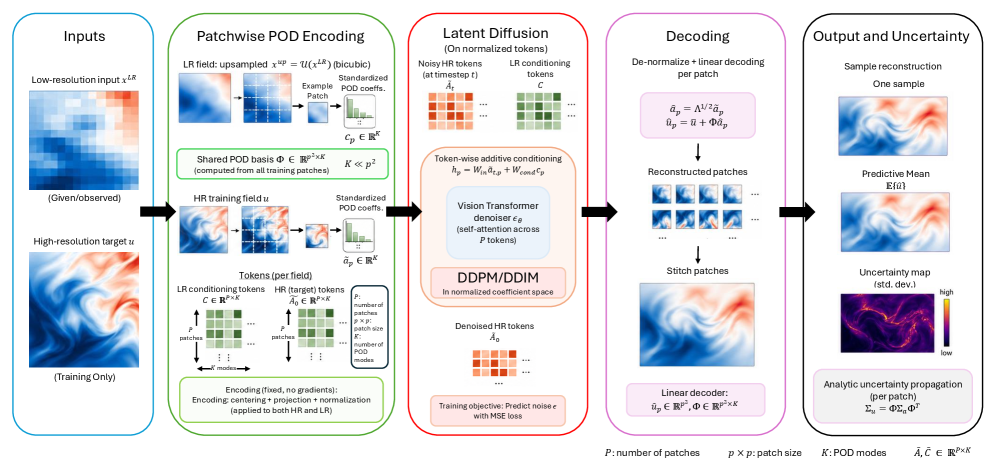
The diagram follows a field from low-resolution conditioning and patchwise POD encoding through Vision Transformer denoising, linear reconstruction and analytical uncertainty propagation.
Read the paper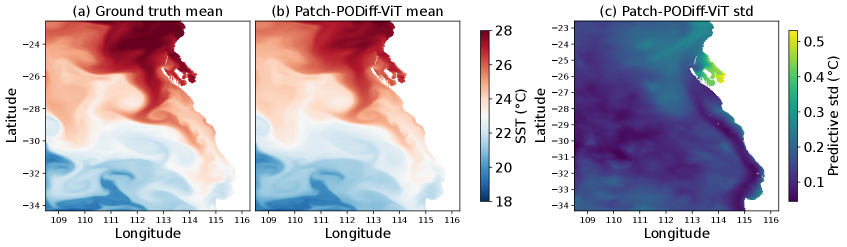
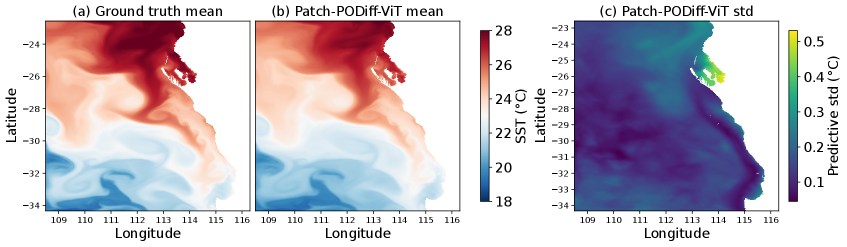
Ground-truth SST, ensemble mean and predictive standard deviation for a representative day during the 2011 Western Australian marine heatwave. Uncertainty increases near coastlines and strong temperature gradients.
View source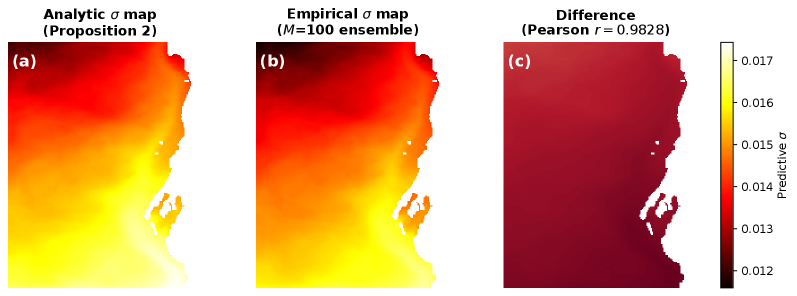
The analytical standard-deviation map closely matches uncertainty estimated from 100 decoded ensemble members. The difference panel tests whether the efficient propagation formula preserves spatial magnitude and structure.
View source