Scientific machine learning · Generative AI · 2026
PODiff
Latent diffusion in Proper Orthogonal Decomposition space for efficient, interpretable scientific super-resolution.
The University of Western Australia
International Conference on Machine Learning (ICML), 2026
Abstract
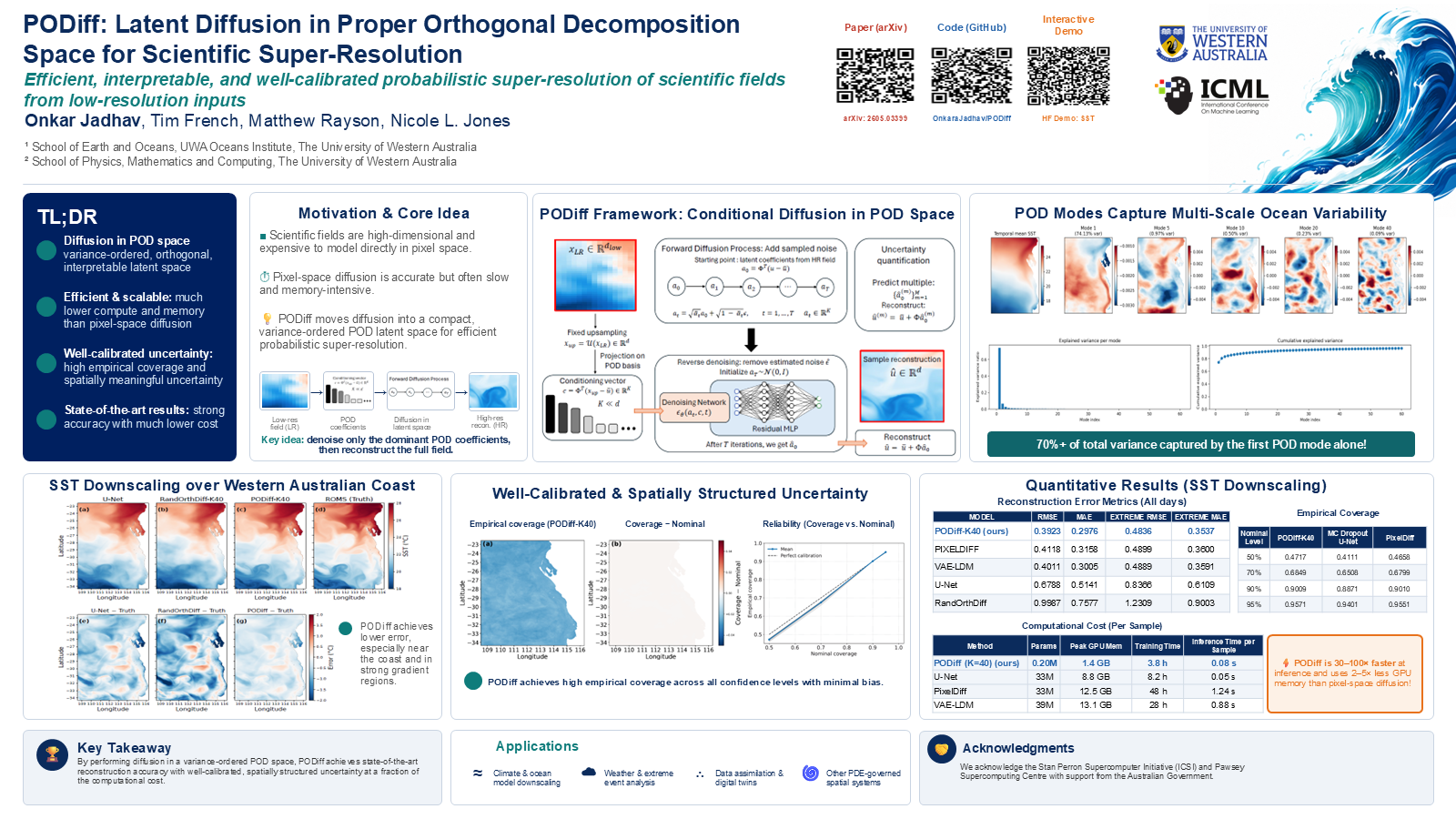
Probabilistic super-resolution of high-dimensional spatial fields using diffusion models is often computationally prohibitive due to the cost of operating directly in pixel space. We propose PODiff, a structured conditional generative framework that performs diffusion in a fixed, variance-ordered Proper Orthogonal Decomposition (POD) coefficient space, exploiting the orthogonality of POD modes to impose an interpretable, variance-ordered latent geometry. This design enables efficient ensemble generation, preserves dominant spatial structure, and yields spatially interpretable, well-calibrated uncertainty at substantially lower computational cost. We evaluate PODiff on sea surface temperature downscaling over the West Australian coast and on a controlled advection--diffusion benchmark. PODiff achieves reconstruction accuracy comparable to pixel-space and learned-latent diffusion while using a substantially smaller structured latent space, requiring significantly less memory, and producing more reliable uncertainty estimates than deterministic and Monte Carlo Dropout baselines.
Introduction
Scientific super-resolution is not only a reconstruction problem. A useful model must also represent the range of plausible fine-scale states consistent with a coarse input. Pixel-space diffusion can generate such ensembles, but it carries a high memory and inference cost for large spatial fields. Autoencoder-based latent diffusion is cheaper, although a learned nonlinear latent space makes individual coordinates—and their uncertainty—hard to interpret physically.
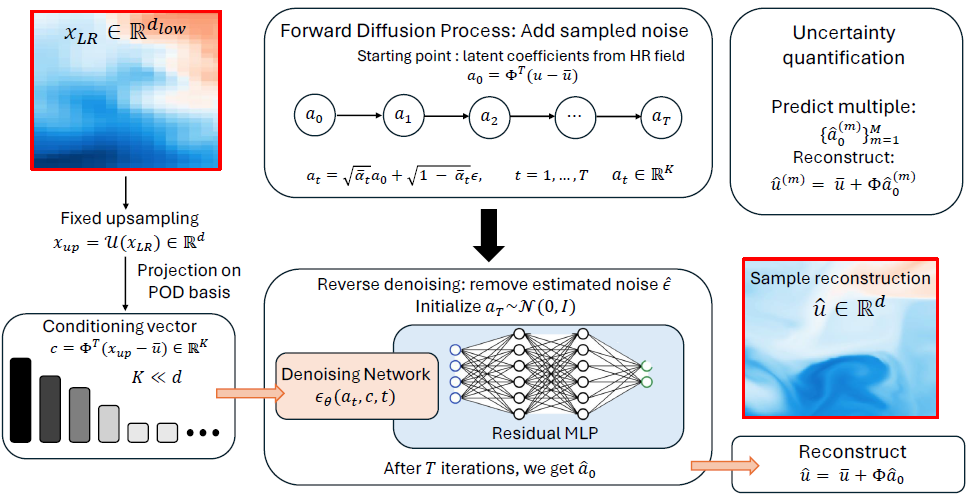
- Goal
- Generate plausible high-resolution scientific fields and spatial uncertainty efficiently from coarse observations.
- Key idea
- Perform conditional diffusion in a fixed, variance-ordered POD coefficient space and reconstruct samples through the same orthonormal basis.
- Takeaway
- A compact and physically interpretable latent representation supports efficient ensembles and well-calibrated uncertainty at lower computational cost.
Methodology
PODiff first computes a fixed Proper Orthogonal Decomposition basis from high-resolution training fields. Fine-scale targets are projected into variance-ordered POD coefficients, and a conditional diffusion model learns to generate those coefficients from a coarse observation. Reverse-diffusion samples are decoded through the same orthonormal basis to produce an ensemble of high-resolution fields.
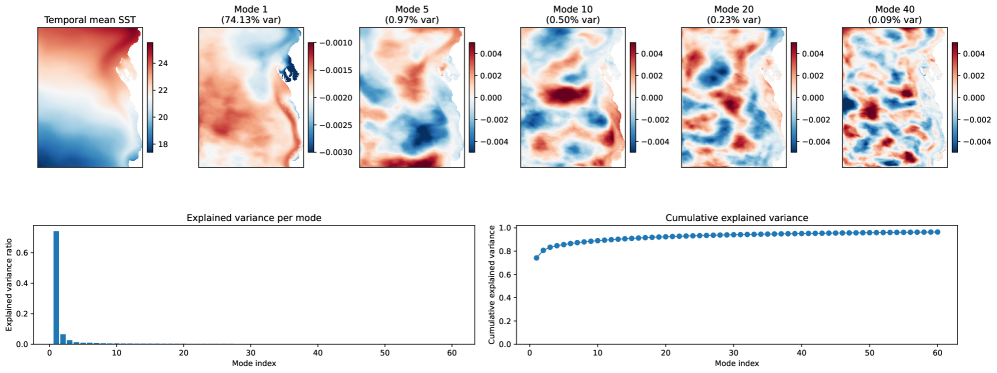
This construction separates spatial representation from probabilistic generation. Dominant modes capture coherent large-scale structure, while later modes represent progressively finer variability.
Results and significance
- An interpretable latent geometry whose coordinates correspond to ordered physical modes rather than learned features.
- Substantially lower memory and computational cost than direct pixel-space diffusion.
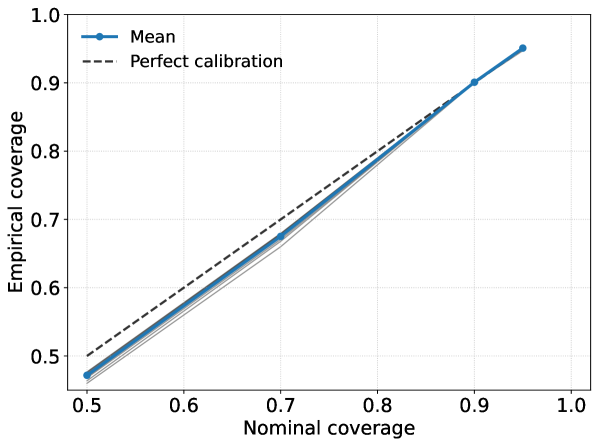
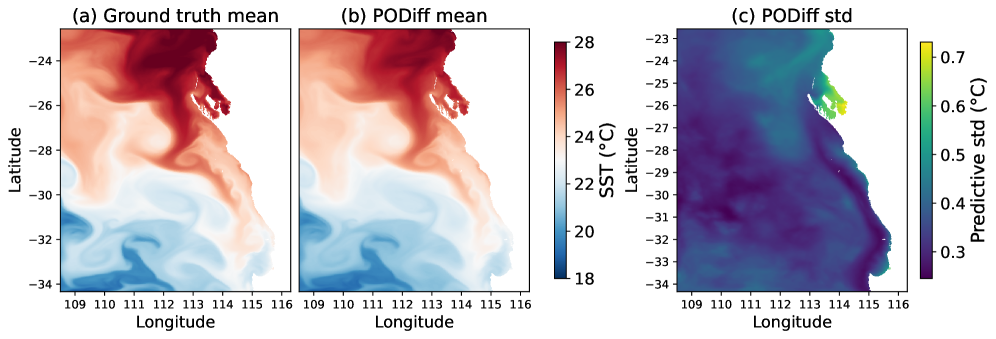
- Direct analysis of mode-wise and spatial predictive uncertainty.
- A common framework for Western Australian sea-surface-temperature downscaling and a controlled advection–diffusion benchmark.
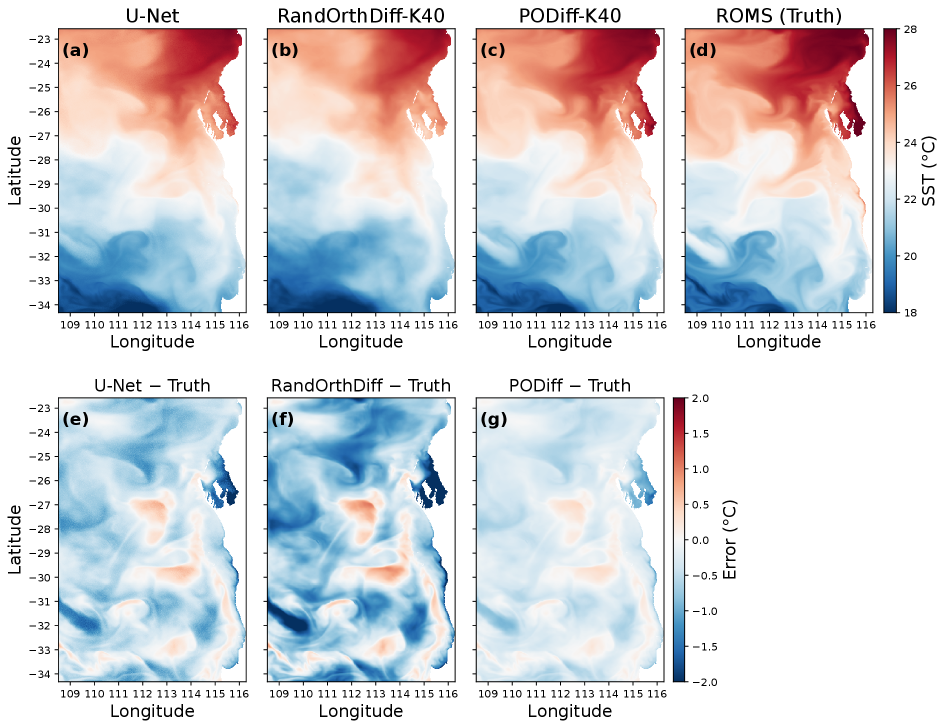
PODiff achieved reconstruction quality comparable to pixel-space diffusion while using less memory and producing better-calibrated uncertainty than deterministic and Monte Carlo Dropout baselines. The work was accepted at ICML 2026 and provides a reusable route for probabilistic super-resolution of high-dimensional scientific fields.
Reconstruction accuracy
| Model | RMSE | MAE | Extreme RMSE | Extreme MAE |
|---|---|---|---|---|
| PODiff-K40 | 0.3923 | 0.2976 | 0.4836 | 0.3537 |
| PODiff-K20 | 0.5171 | 0.3923 | 0.6373 | 0.4661 |
| PODiff-K10 | 0.7725 | 0.5861 | 0.9521 | 0.6964 |
| POD-proj | 0.7084 | 0.5223 | 0.8896 | 0.6305 |
| PixelDiff | 0.4118 | 0.3158 | 0.4899 | 0.3600 |
| U-Net | 0.6788 | 0.5141 | 0.8366 | 0.6109 |
| U-Net (reduced) | 0.6819 | 0.5273 | 0.8415 | 0.6111 |
| RBF | 0.7784 | 0.5804 | 0.7899 | 0.5936 |
| RandOrthDiff | 0.9987 | 0.7577 | 1.2309 | 0.9003 |
Values are in °C and are averaged over all 365 test days in 2011; extreme events are climatological 90th-percentile exceedances. Standard deviations across five training runs are below 0.01 for all models. Source: paper Table 1.
Uncertainty quantification
Computational efficiency
| Method | Parameters | Peak GPU memory | Training time | Inference / sample |
|---|---|---|---|---|
| U-Net | 33M | 8.8 GB | 8.2 h | 0.05 s |
| PODiff (K=40) | 0.20M | 1.4 GB | 3.8 h | 0.08 s |
| RandOrthDiff (K=40) | 0.20M | 1.4 GB | 3.8 h | 0.08 s |
| PixelDiff | 33M | 12.5 GB | 48 h | 1.24 s |
Diffusion-model inference includes all denoising steps; U-Net inference is one deterministic forward pass. Measurements were made on AMD Instinct MI250X GPUs on Setonix. Source: paper Table 3.
Technology and data
Python, PyTorch, diffusion models, POD/SVD, xarray, NetCDF, Western Australian sea-surface-temperature fields, Setonix and NCI/Gadi HPC environments.
Research outputs
BibTeX
Cite the accepted ICML 2026 paper:
@inproceedings{jadhav2026podiff,
  title     = {{PODiff}: Latent Diffusion in Proper Orthogonal
               Decomposition Space for Scientific Super-Resolution},
  author    = {Jadhav, Onkar and French, Tim and Rayson, Matthew
               and Jones, Nicole L.},
  booktitle = {Proceedings of the 43rd International Conference
               on Machine Learning},
  year      = {2026},
  url       = {https://openreview.net/forum?id=xCnJEgFKVC}
}