Medical imaging · Generative AI
medPODiff
Uncertainty-aware generative AI for brain-MRI reconstruction and hallucination-risk detection.
The University of Western Australia
Ongoing research · 2026–present
Abstract
medPODiff extends uncertainty-aware generative AI to medical imaging, with current work on brain-MRI reconstruction, calibrated uncertainty and hallucination-risk detection.
Introduction
Medical-image reconstruction can produce plausible-looking anatomy even when some fine detail is weakly supported by the acquired measurements. In this high-stakes setting, reconstruction quality alone is not enough: a useful method should also communicate where its output may be unreliable.
- Goal
- Reconstruct high-resolution brain MRI while showing where recovered detail may be uncertain or unsupported.
- Key idea
- Generate a distribution of plausible reconstructions and assess predictive uncertainty alongside image quality.
- Takeaway
- This is ongoing research; evaluation is focused on reliability and hallucination risk, and no completed result or publication is claimed.
Approach
The project explores conditional generative models that reconstruct high-resolution MRI while retaining a distribution over plausible outputs. It builds on the uncertainty-aware principles developed in PODiff and Patch-PODiff-ViT, extending structured generative modelling to medical data.
Reconstruction and reliability are considered together so uncertainty information can indicate where generated anatomy may not be sufficiently supported by the available input.
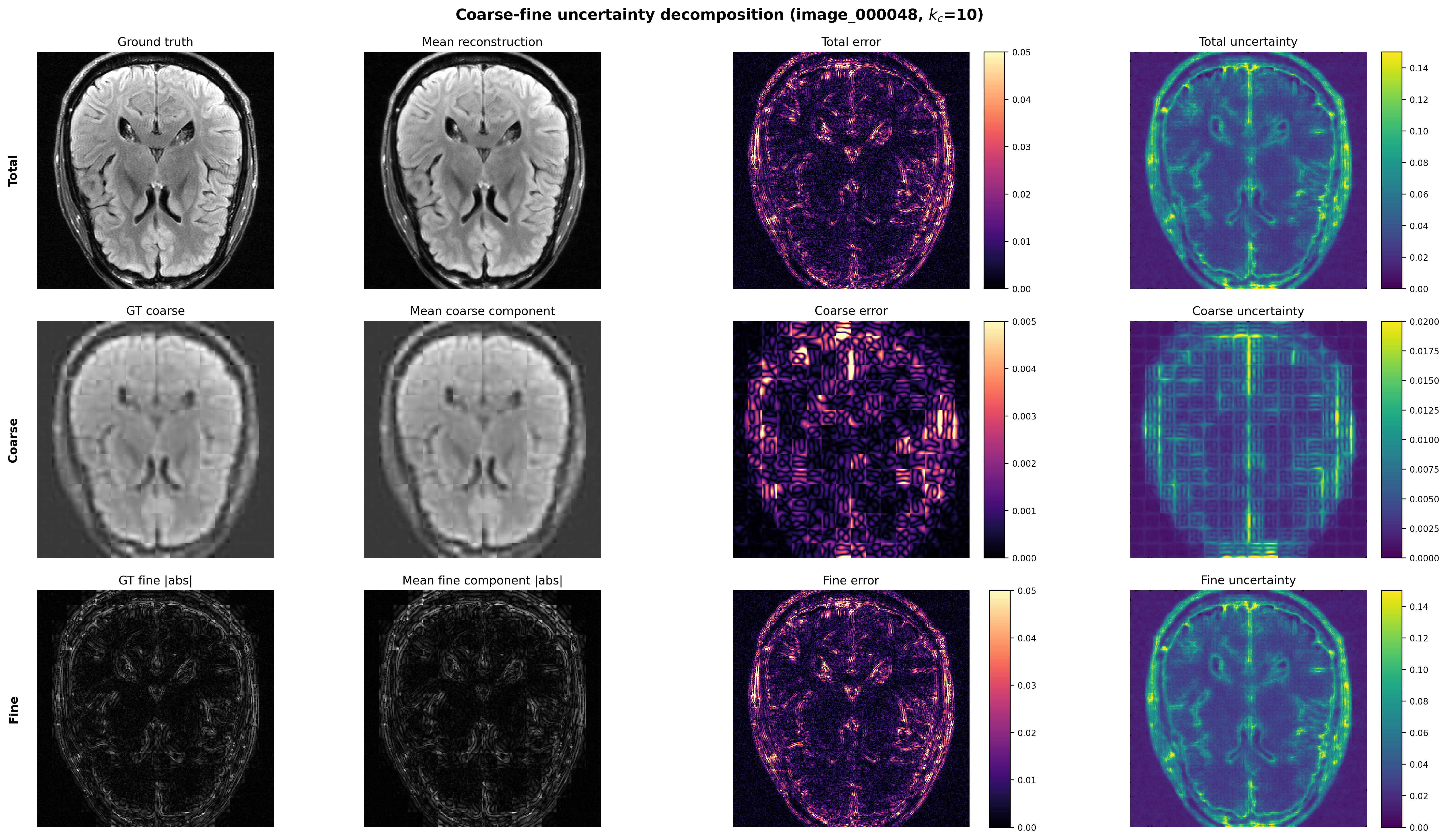
Ongoing qualitative evaluation
This in-progress example illustrates the current evaluation workflow. It is presented as a qualitative research artefact, not as a published benchmark result or completed clinical evidence.
Evaluation
Current evaluation studies reconstruction quality, calibrated predictive intervals, scale-dependent uncertainty and indicators of hallucination risk. The aim is to distinguish supported reconstruction detail from plausible-looking content that may not be justified by the measurements. The work remains in progress, so no completed performance result is reported here.
BibTeX
Until a paper is released, cite medPODiff as an unpublished research project:
@unpublished{jadhav2026medpodiff,
  author = {Jadhav, Onkar},
  title  = {{medPODiff}: Uncertainty-Aware Generative AI for
            Brain-MRI Reconstruction and Hallucination-Risk Detection},
  year   = {2026},
  note   = {Ongoing research project; not yet published}
}
This entry deliberately does not claim a venue, DOI or archived paper.
Research setting
medPODiff is ongoing research at The University of Western Australia. Its current scope combines brain-MRI reconstruction, uncertainty-aware generative modelling and reliability assessment for medical-image super-resolution.